Every company needs an agent strategy by 2027
I quit my job six months ago to watch every company I know get stuck in the same AI-pilot trap. Here's why the ones still debating 'which tool' in 2026 will be uncompetitive by 2027.
I quit my job six months ago to build agent infrastructure because I kept watching the same thing happen in every company I talked to.
Leadership reads a McKinsey report. Approves an "AI initiative." Green-lights three pilots. Six months later, nothing is in production. The demos impress in meetings. Nobody uses them. The budget gets cut the next cycle. Repeat.
This is not an AI problem. It is an infrastructure problem, and the companies that solve it in 2026 will be operating at a fundamentally different cost structure by 2027 than the ones that don't.
The shift that already happened
In 2023, "AI strategy" meant picking a chatbot. In 2024, it meant wiring LLM calls into dashboards. By 2025, the leaders stopped thinking about AI as a feature and started thinking about it as a workforce.
That is the shift. Not better autocomplete. Not smarter search. A workforce of goal-directed software that does entire jobs — research, triage, outreach, review — with human oversight instead of human effort.
The question is no longer which tool. The question is what happens to your cost structure when 40% of the work that required employees gets done by software that reasons.
Why the pilots don't ship
I have watched enough of these to see the pattern.
Teams pick a framework — LangChain, CrewAI, something with a graph abstraction — and spend four weeks wiring it up. They build a demo. The demo works in the happy path. Someone runs it on a real ticket, a real document, a real customer email, and it falls apart.
Now they are stuck. The framework assumed the happy path. Production never looks like the happy path. Fixing the edges means rewriting the graph. Rewriting the graph means relearning the framework. So the pilot dies, and the next one starts from scratch six months later with a different framework.
This is the loop. It is not a capability problem — the models are ready. It is not a talent problem — the engineers are capable. It is an infrastructure problem: there is nothing between "raw LLM call" and "production agent" that actually works at scale.
The cost gap, drawn
A mid-market company with 500 knowledge workers at $80K fully-loaded runs a $40M labor line.
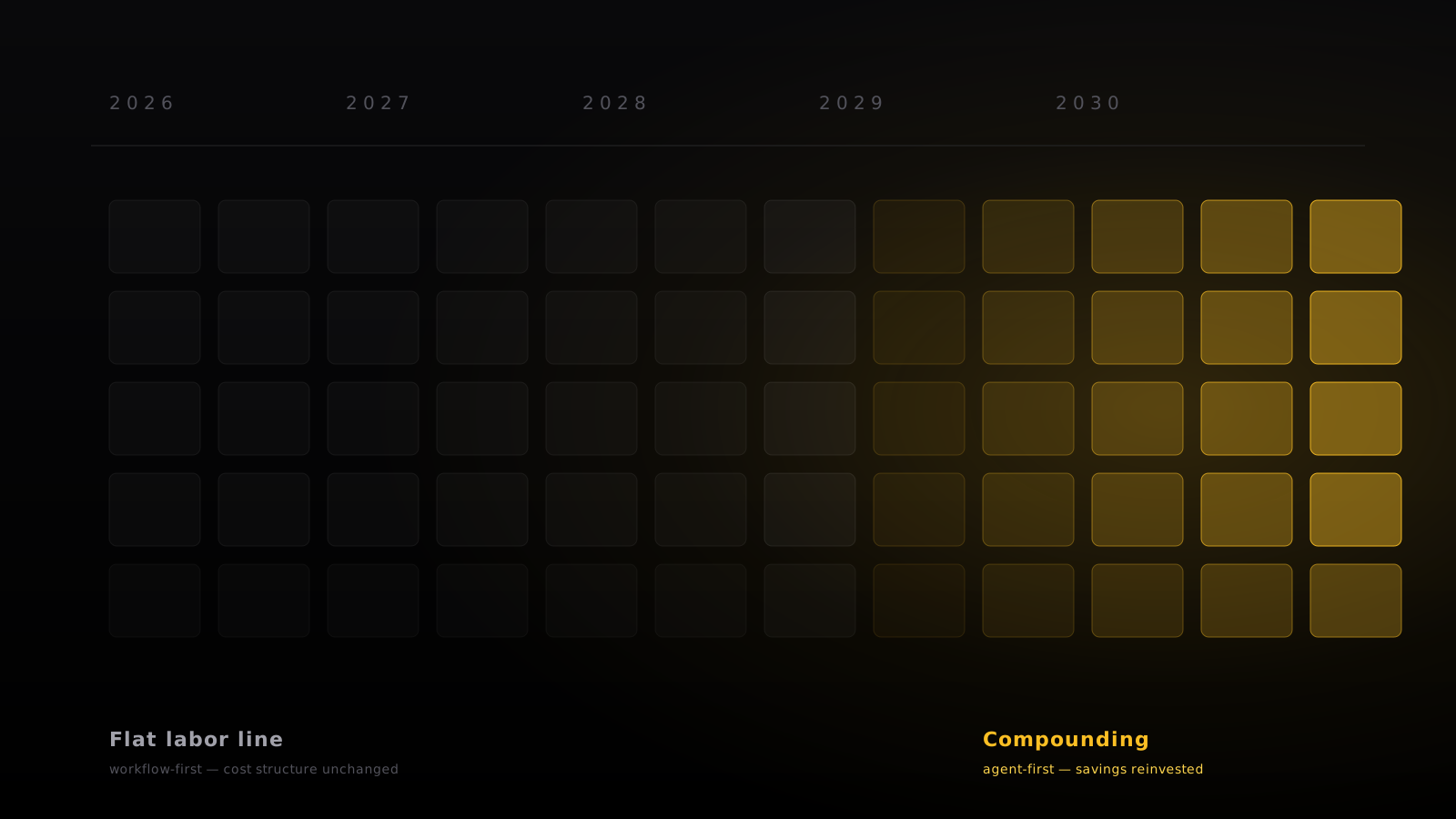
If agents absorb 20% of that by 2027 — and 20% is the floor, not the ceiling — the adopter is sitting on an $8M structural cost advantage against the laggard. At 15% margins, $8M is the difference between a healthy business and a distressed one.
Over five years the gap becomes uncloseable, because the savings get reinvested into more agents, more coverage, more leverage. This is how structural advantages compound.
What the companies pulling ahead actually do
Three things.
They pick a platform that treats agents like software, not prompts. Signed containers. Declared permissions. An actual debugger. If your AI strategy does not include the words observability and sandboxing, it is a toy, not infrastructure.
They ship one agent before they build ten. The standard failure is launching five pilots at once, none reaching production. The pattern that works: pick the single highest-leverage workflow — the one eating the most human hours — and ship one agent that does 80% of it. Measure the hours saved. Use that budget to fund the next.
They make agents composable from day one. An agent that does research is useful. A research agent that hands off to a drafting agent that hands off to a review agent is a team. Composability is where compounding shows up. If your first agent is a silo, your tenth will also be a silo.
2027 is not arbitrary
The competitive baseline is moving. By the end of 2027, Apple's agent layer will be ambient. Microsoft's will be in every Office seat. Every major SaaS vendor will have shipped "agent support" — most of it will be bad, some of it excellent. The floor for "does your company use agents" will be higher than most leadership is planning for.
The companies that have an agent strategy by then will be competing on a fundamentally different cost structure. The ones that don't will be explaining to their boards why their competitors grew margins 20 points while they stayed flat.
Start this week
You do not need a hundred-person AI team. You need:
agent_strategy:
  platform_decision:
    by: 2026-Q3
    criteria: [signed_containers, declared_permissions, observability]
  first_agent:
    ship_within: 30_days
    workflow: highest_human_hours
    target: 80%_coverage
  executive_sponsor:
    treats_as: pnl_lever
    not_as: rnd_line_item
The rest follows. The window is not closing. It is already narrower than you think, and every month the companies that got there first compound further out of reach.